


Is California Becoming a Fraudster’s Paradise? Examining Concerns Over Election Security

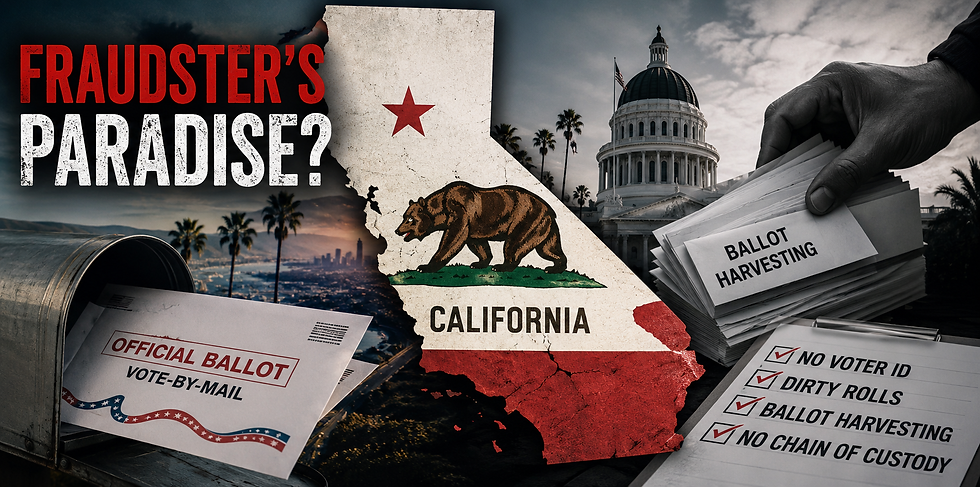
California has long been at the center of national debates over election policy, healthcare spending, and government oversight. Critics argue that the state’s efforts to increase accessibility have come at the expense of accountability, creating opportunities for fraud that are difficult to detect or prosecute. California’s election system has evolved into one where safeguards have steadily been removed over decades, making the state particularly vulnerable to abuse.
One of the primary concerns raised is California’s voter registration process. Individuals can register to vote without providing a Social Security number or driver’s license by indicating they do not possess either form of identification.
While state officials maintain that first-time voters may still be required to verify their identity, critics contend that the list of acceptable identification documents is so broad that it weakens the verification process. Documents such as employer identification cards, prescription labels, gym memberships, and health insurance cards are cited as examples of identification that offer limited protection against fraudulent registration.
California’s universal vote-by-mail system is another major focus of criticism. Under this system, every registered voter automatically receives a ballot by mail. Supporters view the policy as a way to increase voter participation and accessibility. However, mailing millions of ballots creates unnecessary risk if voter registration rolls are not regularly updated.
Outdated voter rolls may still contain deceased individuals, people who have moved away, or others who are no longer eligible to vote, potentially resulting in ballots being sent to incorrect recipients.
Perhaps the strongest criticism centers on ballot collection, often referred to as ballot harvesting. California law now permits third parties to collect completed ballots from voters, replacing previous restrictions that largely limited ballot handling to family members or the voters themselves. The concern is not simply that ballots are collected by others, but that there is little documented chain of custody showing who handled a ballot from the moment it leaves the voter until it reaches election officials. Critics argue that without detailed tracking or documentation, investigators face significant challenges when attempting to verify allegations of fraud or misconduct.
It's also important to highlight the practical difficulties prosecutors encounter when pursuing election fraud cases. Fraud investigations typically rely on evidence, documentation, and clear chains of custody. California’s election laws have eliminated many of the records investigators would normally use to reconstruct events or establish criminal intent.
As a result, even if misconduct occurred, proving it beyond the legal standard required for prosecution may be extremely difficult.
Many have begun advocating for a comprehensive audit of California’s voter registration rolls.
Some cite ongoing litigation seeking compliance with the federal Help America Vote Act (HAVA), which requires states to maintain accurate voter registration lists. The lawsuit aims to verify that only eligible U.S. citizens appear on the state’s voter rolls and that the state is meeting its federal obligations. California officials have resisted requests to provide records needed for independent verification, resulting in continued legal battles.
The issues raised reflect a broader national debate over election administration.
Supporters of California’s election system argue that policies such as universal vote-by-mail and expanded ballot collection increase voter participation and reduce barriers to voting. Critics counter that these same policies may reduce transparency and make fraud investigations more difficult by weakening verification procedures and documentation requirements.
Whether one views California’s election policies as a model for expanding democratic participation or as a system in need of stronger safeguards, the debate continues to shape conversations about public trust in elections.
Reduced verification standards, broad ballot collection laws, and challenges in maintaining accurate voter rolls create vulnerabilities that deserve greater scrutiny. As legal challenges move through the courts and policymakers continue to debate reforms, the conversation over election security in California is unlikely to fade anytime soon.


Comments